
Boiler Service in Rotherham and Barnsley: Keep Your Home Safe and Warm All Year
Annual boiler service £114 inc VAT across Rotherham and Barnsley. System water testing, combustion analysis and a written record. Gas Safe registered.
Annual service from£114including VAT · Band A £132
- Gas Safe registered 584578
- Heat Geek Assured
- 100+ 5-Star reviews on Google
- In the trade since 2009
- DBS checked
Signs Your Boiler Needs Attention Before It Fails
Quick Summary: A boiler rarely fails without warning, it usually gives you small clues first. Strange noises, a pilot light that keeps going out, or a sudden jump in your gas bill are all worth checking before winter hits. Catching these early with a boiler service often saves you from a cold house and a much bigger repair bill later.
Nine times out of ten, a boiler tells you it's struggling before it quits on you completely. The trouble is, most people don't know what to listen for. We get called out plenty of times where the homeowner admits the noise started weeks ago and they'd just hoped it would sort itself out. It rarely does.
- Banging, whistling, or gurgling sounds coming from the boiler or pipes
- The pilot light keeps going out or burns yellow instead of blue
- Your radiators heat unevenly, cold at the top or bottom
- Water pressure keeps dropping even after you top it up
- Your gas bill has crept up without any change in how you use heating
A lot of homes around Rotherham and Barnsley have older combi boilers fitted into terraced properties built during the coal-mining era, and those systems tend to show wear differently than a newer install. A yellow flame, in particular, isn't something to wait on. It can point to incomplete combustion, and that's a safety issue, not just a performance one.
Is a bit of noise really worth a call out? Honestly, yes. Small issues caught during a service are simple fixes. Left alone, they turn into strip-down jobs, or worse, a full breakdown in the middle of January.
A Text Before We Arrive, So You're Not Waiting in All Day
Nobody wants to take a whole day off work waiting for an engineer. Every booking comes with a 4-hour slot, morning (8am to 12pm), mid-day (10am to 2pm) or afternoon (12pm to 4pm), so you know which part of the day to keep free, and a set time is available for £30 extra. When you book a boiler service with us you get an email straight away, a reminder the day before, and a text when your engineer is on the way, with a link so you can follow them to your door.
It is the thing our customers mention more than anything else.
Before Chris arrived today, we got notification that he was on his way and was 16 mins away. Exactly 16 mins later he was parked up on our driveway.
What a Standard Boiler Service Involves
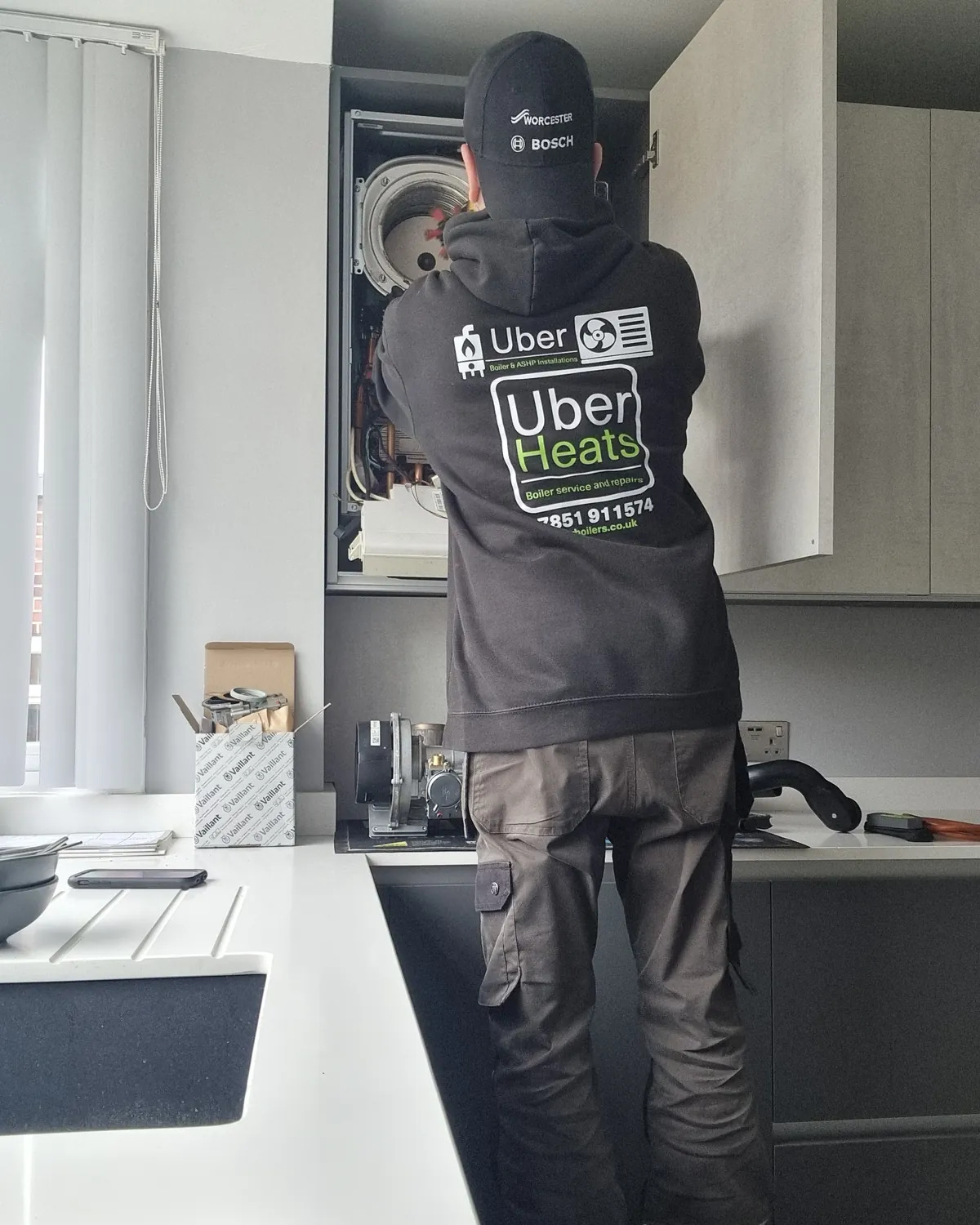
A genuine boiler service is far more than a quick glance and a signature. Gas Safe registered engineers working to Heat Geek Assured standards follow a structured sequence every time they attend a property, whether it's a Victorian terrace near Rotherham town centre or a newer build out towards Waverley. The process is designed to catch faults before they become breakdowns or safety hazards, and it should always be traceable through clear documentation left with the homeowner.
- Visual and functional checks: the engineer inspects the casing, seals, pipework, and controls for corrosion, leaks, or wear, then operates the boiler through its full cycle to confirm it fires, modulates, and shuts down correctly.
- System water test: a sample is taken to check inhibitor levels and look for signs of sludge or magnetite buildup, which is common in older properties with original cast iron radiators and can quietly damage heat exchangers.
- Flue and ventilation check: the flue is examined for secure joints, correct termination position, and adequate clearance, while room ventilation is confirmed to meet current gas safety regulations, particularly important in tightly packed terraced housing.
- Safety device and combustion test: the engineer tests the flame failure device, pressure relief valve, and other safety mechanisms, then uses calibrated combustion analysis equipment to measure flue gas readings against manufacturer tolerances.
- Written summary: a full service record is completed detailing readings taken, parts inspected, any faults found, and recommendations, giving you a document for warranty claims, landlord compliance, or future reference.
Each stage matters on its own, but together they build a complete picture of boiler health rather than a surface-level check. Combustion readings, for example, can reveal an inefficient burn long before you notice reduced heat output or higher gas bills. Flue inspections catch problems that are invisible during everyday use but pose serious carbon monoxide risks in the enclosed rooms typical of older Rotherham and Barnsley properties.
Expect to see this process followed in full, with proper time taken at each step rather than a rushed fifteen-minute visit. Asking to see the combustion analyser readings or the written summary afterwards is a reasonable request, and a useful way to judge whether a service has actually been carried out properly.
Standard Service or Full Strip-Down Clean
Most boilers just need a standard service. Our engineer checks the system water, inspects the flue, tests safety controls, and confirms everything is running efficiently. This takes 30 to 45 minutes for most homes.
But some boilers need more. A lot of the older semi-detached homes around the Dearne Valley still run on original pipework from decades ago, and hard water across this part of Yorkshire leaves limescale and sludge sitting in that system year after year. When we open the casing and find heavy scale build-up or a corroded heat exchanger, a quick check won't cut it.
That's when a full strip-down clean comes in. We take the boiler apart, clean the internal components properly, and put it back together tested and working. This job runs closer to 1.5 hours, and it costs more because it takes more time and, in some cases, extra parts.
- Standard service, system water testing, includes a check of the flue and safety controls
- Full strip-down clean, internal components cleaned, extra time and parts quoted separately if needed
- Back boilers and fires are excluded from both service types
Pricing runs £114 for standard postcodes and £132 for Band-A postcodes, including VAT — check your postcode on our rates page. Add £30 if you need a set appointment time rather than a standard 4-hour slot. We quote any strip-down parts separately once we've had a proper look inside. Often a standard service is all that's needed, but we just won't know for certain until the panel comes off.
When You Don't Need a Full Service Call
Not every boiler niggle needs a Gas Safe engineer on the doorstep. Two of the most common calls we get, a boiler showing low pressure or a radiator that stays cold at the top, are often things you can sort yourself in ten minutes, without touching a spanner beyond what came in the box with your combi.
If your pressure gauge sits below 1 bar, your boiler is simply low on water in the sealed system, not broken. Most combi boilers, including the Worcester Bosch and Baxi models common in older ex-colliery terraces and on newer estates alike, have a filling loop, a flexible braided hose linking the cold mains to the heating system. With the boiler off, open both valves slowly until the gauge reads 1 to 1.5 bar, then close them again. Takes a few minutes and costs nothing.
A radiator that's cold at the top but warm at the bottom usually means trapped air, not a failing boiler or pump. Bleeding it with a radiator key, sold cheaply at any local hardware shop, releases the air and lets hot water circulate properly again. You'll hear a hiss, then water will spit out, so have a cloth ready and re-check your system pressure afterwards, since bleeding can drop it slightly.
- Gauge reading below 1 bar with no other faults: usually a repressurising job, not an engineer visit
- One or two radiators cold at the top only: almost always trapped air, fixed by bleeding
- All radiators cold and pressure fine: this points to a pump, valve, or diverter issue and does need an engineer
- Pressure that keeps dropping repeatedly within days: worth a proper look, as it suggests a leak or faulty component rather than a one-off
None of this replaces your annual boiler service. Repressurising and bleeding fix symptoms, not the underlying wear on heat exchangers, seals, or flue components that only a full inspection catches. We’d rather talk you through a free five-minute fix over the phone than book you in for a visit you didn’t need. That’s how trust gets built, one honest answer at a time.
A boiler service looks at the boiler itself. If you'd like the whole setup checked in one visit, with the cylinder, controls, valves and pump looked at together, that's our heating system maintenance across Rotherham and Barnsley. And if something has already stopped working, book a heating system repair instead.
Landlord Gas Safety Certificates
If you let a residential property, you're legally required to have every gas appliance, flue, and pipework installation checked once every 12 months. A standard boiler service doesn't cover this on its own — it's a separate legal document called a CP12, or Landlord Gas Safety Record.
If you own and live in your own home, a boiler service is all you need. If you’re a landlord, tell us when you book and we’ll arrange a combined service and CP12 visit so it’s one visit rather than two. For the full detail, see our CP12 Gas Safety Inspection page.
What our customers say
Broken down boiler
I found Chris (Uber Heats) on Google after my boiler stopped working. He had good reviews so I called up, his office lady was very polite and managed to get me an appointment the same day. I received both a text and email to confirm this, as well as a text when he was on the way (i could watch him arrive on a map link). He found the fault and had the parts on the van to complete the repair. Great service, great price, highly recomend
Heat source pump servicing
I would recommend this company to anyone who requires any of the services they provide. Its a family run company who are so friendly very helpful and reasonably priced. Chris is a lovely guy and nothing was too much trouble. I will continue ue to use his services in future
Where we work
Our standard rate covers all of Rotherham (S60, S61, S62, S65 and S66), the Dearne Valley (S63 for Wath upon Dearne, Bolton upon Dearne, Goldthorpe and Thurnscoe, and S64 for Mexborough, Swinton and Kilnhurst), all of Barnsley (S70 to S75), Doncaster (DN1, DN2, DN4, DN5, DN6 and the north of DN12) and north and east Sheffield (S4, S5, S9 and S35). Chesterfield, Worksop, Wakefield, Pontefract and the rest of Sheffield outside the city centre are on our Band A rate: the same work, with 10% added for the travel. Not sure which you’re in? Ring 07851 911574 with your postcode and we’ll tell you straight away.
Standard rate
- S60
- S61
- S62
- S65
- S66
- S63
- S64
- S70
- S71
- S72
- S73
- S74
- S75
- DN1
- DN2
- DN4
- DN5
- DN6
- DN12
- S4
- S5
- S9
- S35
- WF9
Band A: same work, 10% added for travel
- S7
- S8
- S10
- S11
- S12
- S13
- S14
- S17
- S20
- S21
- S26
- S36
- S25
- S18
- S32
- S33
- S40
- S41
- S42
- S43
- S44
- S80
- S81
- NG20
- DN10
- DN11
- DN22
- DN3
- DN7
- DN8
- DN9
- DN21
- WF1
- WF2
- WF3
- WF4
- WF5
- WF6
- WF7
- WF8
- WF10
- WF11
- HD8
- HD9
Related services
Frequently Asked Questions
How long does a boiler service take?
A standard boiler service takes 30 to 45 minutes for most homes. If we find heavy limescale or sludge inside, which is common in older properties on hard water, a full strip-down clean can run closer to 1.5 hours. We won't know which job your boiler needs until the casing comes off. That's why we always check first rather than guessing from the doorstep.
How much does a boiler service cost in Rotherham and Barnsley?
Our boiler service is £114 including VAT for standard postcodes and £132 for Band A postcodes. If you need a set appointment time rather than a standard 4-hour slot, there's a £30 charge on top. You can check which band your postcode falls into on our rates page.
What happens when the engineer arrives for a boiler service?
The engineer starts with a visual check of the casing, seals, and pipework before running the boiler through a full cycle to see how it fires and shuts down. They'll test a water sample, check the flue and ventilation, and run a combustion analysis to measure flue gas readings. You'll get a written summary at the end showing what was checked and any faults found. It's fair to ask to see those readings before they leave.
My boiler is making a strange noise, does it still need a service?
Yes, noise is one of the clearest signs your boiler needs checking soon. Banging, whistling, or gurgling from the boiler or pipes usually means something is starting to go wrong inside. Left alone, small issues like this tend to turn into bigger strip-down jobs or a full breakdown in the middle of winter. Catching it early during a service is almost always the simpler fix.
How do I know if my boiler needs a full strip-down clean instead of a standard service?
You won't know for certain until an engineer opens the casing and checks the internal components. A standard service covers the water test, flue inspection, and safety controls, which is enough for most boilers. But if there's heavy scale or a corroded heat exchanger underneath, a strip-down clean is needed to take it apart, clean it properly, and test it before putting it back together.
What does a yellow pilot light flame mean for my boiler?
A yellow flame instead of blue usually points to incomplete combustion, which is a safety issue rather than just a performance problem. This is something you shouldn't wait on, especially in older homes where tighter room ventilation can make carbon monoxide risks more serious. A service will test the flame failure device and combustion levels to confirm the boiler is burning safely and correctly.
Talk to the office team
Office open Monday to Friday 8am to 6pm, and Saturday 8am to 12pm. Tell us what's going on and we'll book the right visit, in a weekday 4-hour slot: 8am to 12pm, 10am to 2pm or 12pm to 4pm.