
Boiler Repairs in Rotherham and Barnsley: Gas Safe Fixes for Local Homes
Gas Safe boiler repairs across Rotherham and Barnsley from £114 inc VAT. Same-day where we can, Monday to Friday.
Diagnostics from£114first hour, including VAT · Band A £132
- Gas Safe registered 584578
- Heat Geek Assured
- 100+ 5-Star reviews on Google
- In the trade since 2009
- DBS checked
Common signs a boiler needs repair
Quick Summary: Strange noises, radiators that never quite warm up, and a boiler that keeps losing pressure are the clearest signs something's wrong. Catch them early and you're usually looking at a quick, cheap fix rather than a full breakdown.
Boilers rarely fail out of nowhere. There's almost always a warning first — you just need to know what you're listening for.
We get called out to plenty of terraced houses around Rotherham and Barnsley with older combi systems, and often the pressure gauge tells the story before the homeowner's finished explaining what's going on. A boiler that keeps dropping below one bar is losing water somewhere, and that's not something it fixes on its own.
- Banging, gurgling, or whistling noises from the boiler or pipes
- Radiators that stay cold at the top or take forever to heat up
- Pressure gauge sitting low or swinging without explanation
- Pilot light that's yellow or orange instead of blue
- Boiler switching off mid-cycle or refusing to fire up at all
- A sudden jump in your gas bill with no change in how you use heating
That yellow flame is the one we never let slide. It can mean incomplete combustion, and that's a carbon monoxide risk, not just an inconvenience.
Not sure if a noise is worth a call? If it's new, and it's happened twice, it's worth a call.
Repairs are £114 including VAT at standard rate and £132 in Band A, covering the first hour, then 15-minute increments. Visits come in a 4-hour slot (8am to 12pm, 10am to 2pm or 12pm to 4pm); a set appointment time adds £30. Check which band you're in on our rates page.
When you don't need to call us
Not every heating problem needs an engineer on the doorstep. Plenty of call-outs turn out to be five-minute fixes any homeowner can safely handle, and being upfront about that builds more trust than pretending every fault needs a paid visit.
Low pressure. If the gauge reads below 1 bar, most modern combi boilers — including the Worcester Bosch and Vaillant models common around here — have a filling loop under the boiler. With the boiler off, open both valves slowly until the needle sits between 1 and 1.5 bar, then close them firmly. Under a minute, costs nothing.
Cold at the top, warm at the bottom. That's trapped air. Bleed the radiator with a standard key, turning slowly anti-clockwise until water hisses out then trickles steadily. Have a cloth ready, and re-check your pressure afterwards since bleeding can drop it slightly.
Nothing firing at all. Check the thermostat is set above room temperature and that the programmer hasn't been changed — this catches people out after a power cut. Confirm the gas is on at the meter and that other gas appliances work.
If the pressure keeps dropping again within a day or two, or bleeding doesn't restore heat, that points to a genuine fault — a leak, a failing pressure relief valve, or an airlock from a pump issue. At that point it's worth getting an engineer involved rather than risking making it worse.
Frozen condensate pipes
When temperatures drop below freezing overnight, one of the most common reasons a boiler stops working the next morning is a frozen condensate pipe. This white plastic pipe carries acidic waste water from the boiler to an external drain, and if it runs outside or through an unheated loft or garage it's vulnerable during a cold snap.
When it freezes, a blockage forms and the boiler detects it can't safely dispose of waste water. Most modern combis respond by locking out completely, displaying a fault code and cutting heating and hot water. That's a safety feature rather than a breakdown, and you can often clear it yourself.
- Locate the external condensate pipe — usually white plastic, running down an outside wall to a drain
- Warm it gently with a hot water bottle, warm cloths, or lukewarm water poured over the frozen section, working from the boiler end outward
- Never use boiling water or a naked flame — it can crack the pipe or cause injury
- Reset the boiler once the pipe is clear and check water flows freely from the drain point
- If it keeps happening in cold weather, ask us about insulating or rerouting the pipe
⚠️ If you smell gas
A frozen condensate pipe is a nuisance. A gas smell is an emergency, and it's treated completely differently.
If you smell gas, hear hissing near the boiler, or see a pilot light burning yellow instead of blue, stop all diagnostic attempts immediately. Turn off the gas at the meter if it's safe to reach, open windows and doors, avoid electrical switches and naked flames, and leave the building if the smell is strong.
Call the National Gas Emergency Service on 0800 111 999. The line is free and staffed 24 hours a day. Don't wait to call us — our engineers work Monday to Friday, 8am to 4pm, and a suspected leak needs the emergency service, not a scheduled visit. Once they've made things safe, ring us and we'll sort the repair.
Why repairs in older housing need a system-wide look
A lot of the housing around here was built for mining families — terraces and semis put up quickly, with narrow airing cupboards and pipework never meant to handle a modern combi. That matters more than most homeowners realise.
We see it constantly. A boiler gets swapped into a house with old microbore pipes, and within a year the customer's calling about cold radiators or a noisy pump. The boiler isn't the problem; the system around it is. Fix one without checking the other and you're just delaying the next breakdown.
- Sludge buildup in original cast iron radiators
- Undersized flues that restrict which boiler models fit safely
- Mixed old and new pipework causing pressure and flow problems
- Airing cupboard conversions never checked against current boiler specs
More often than not, the fault we find in these properties traces back to the system rather than the unit. Where sludge is the underlying cause, a power flush or MagnaCleanse fixes what a repair alone won't.
When the fault sits in the wider system rather than the boiler, such as a pump, a valve, the controls or a leak somewhere along the pipework, our heating system repair page for Rotherham and Barnsley explains how we track it down.
You Hear the Cost Before We Fit Anything
A breakdown is stressful enough without wondering what the bill will be. Repairs are £114 including VAT for the first hour (£132 in Band A), then charged in 15-minute steps. Once we have found the fault, we tell you what has failed, what the part costs and what your options are, before anything gets fitted. Then you decide.
Excellent service. Came out really quickly to solve my boiler problem. Quoted costs every inch of the way. Chris was very friendly and helpful.
What happens on a repair visit
It starts with a phone call. We'll ask whether there's an error code on the display, whether you've lost heating, hot water or both, and whether you've noticed any unusual smells, noises or leaks. That helps us arrive with the right parts rather than making a second trip.
On arrival, ask for the Gas Safe ID card before any work starts. It confirms the engineer is currently certified and shows which types of gas work they're registered for.
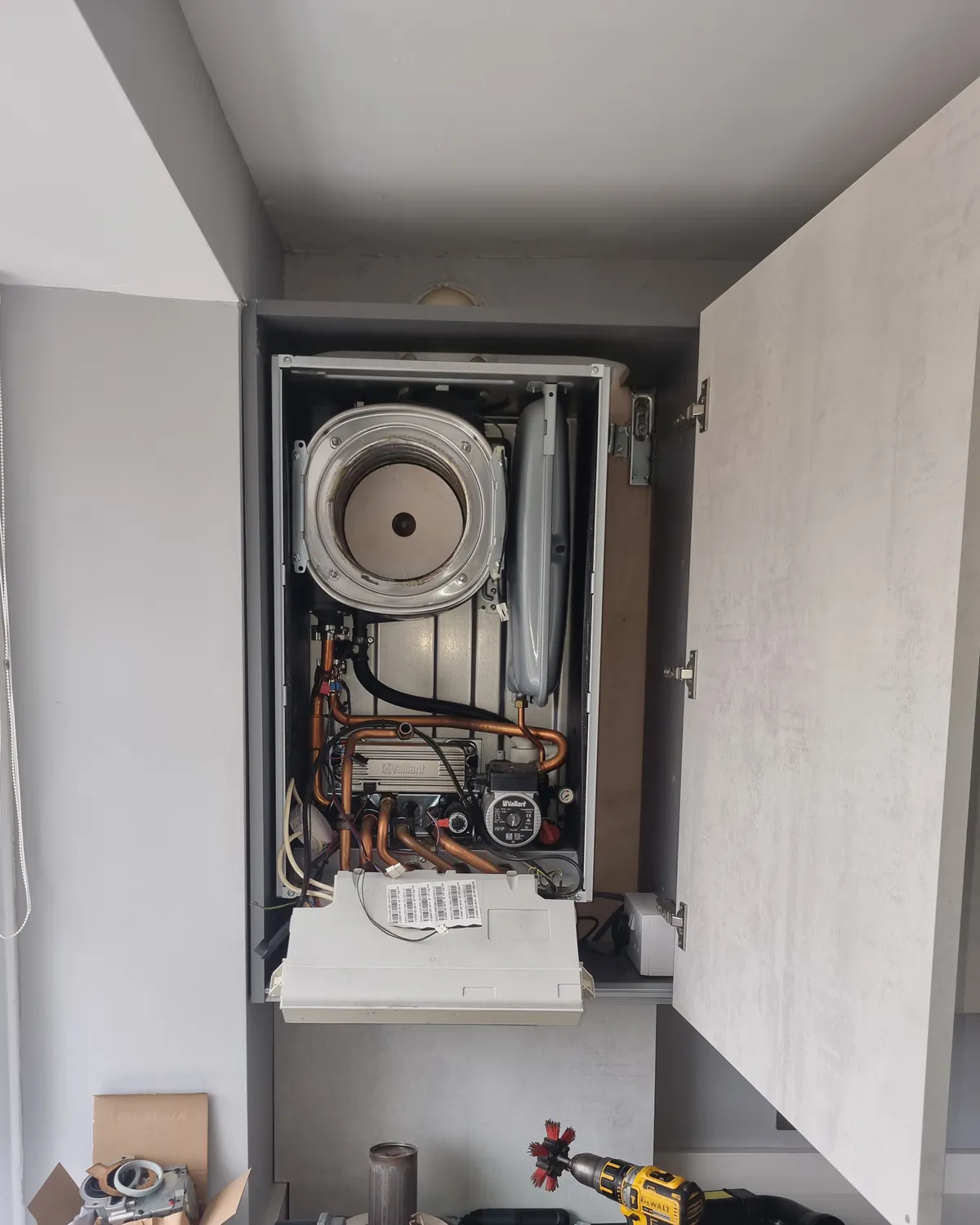
Then a proper diagnosis rather than a guess — fault code history, pressure levels, flue inspection, and a look at the pump, diverter valve, PCB or heat exchanger depending on the symptoms. On older boilers that can take twenty minutes or more before the cause is clear.
Once we've found it, we'll explain what's failed, why, and what your options are, in plain terms. Sometimes the repair happens there and then from parts on the van. Sometimes a specific part needs ordering, which means a follow-up visit.
Every visit ends with a full system test — running the heating, checking hot water at the taps, confirming the boiler fires correctly, holds pressure and reaches temperature without the fault reappearing.
If what we find is a pattern rather than a single fault, we'll tell you straight. There's a point where another repair just delays the inevitable, and our boiler replacement page sets out where that line is.
If you've reached that point and the new boiler can go where the old one is, you can price a like-for-like replacement online before we even visit.
What our customers say
Boiler Repair
Chris arrived on time and the communication before hand was excellent. He repaired my boiler in no time, was friendly and left no mess. I would definitely recommend UberHeats.
Boiler repair
Chris was fantastic, friendly, polite, the work was carried out quickly and he was very tidy. All in all super company, would definitely use UberHeats again.
Where we work
Our standard rate covers all of Rotherham (S60, S61, S62, S65 and S66), the Dearne Valley (S63 for Wath upon Dearne, Bolton upon Dearne, Goldthorpe and Thurnscoe, and S64 for Mexborough, Swinton and Kilnhurst), all of Barnsley (S70 to S75), Doncaster (DN1, DN2, DN4, DN5, DN6 and the north of DN12) and north and east Sheffield (S4, S5, S9 and S35). Chesterfield, Worksop, Wakefield, Pontefract and the rest of Sheffield outside the city centre are on our Band A rate: the same work, with 10% added for the travel. Not sure which you’re in? Ring 07851 911574 with your postcode and we’ll tell you straight away.
Standard rate
- S60
- S61
- S62
- S65
- S66
- S63
- S64
- S70
- S71
- S72
- S73
- S74
- S75
- DN1
- DN2
- DN4
- DN5
- DN6
- DN12
- S4
- S5
- S9
- S35
- WF9
Band A: same work, 10% added for travel
- S7
- S8
- S10
- S11
- S12
- S13
- S14
- S17
- S20
- S21
- S26
- S36
- S25
- S18
- S32
- S33
- S40
- S41
- S42
- S43
- S44
- S80
- S81
- NG20
- DN10
- DN11
- DN22
- DN3
- DN7
- DN8
- DN9
- DN21
- WF1
- WF2
- WF3
- WF4
- WF5
- WF6
- WF7
- WF8
- WF10
- WF11
- HD8
- HD9
Related services
Frequently Asked Questions
How quickly can you get out to a boiler breakdown?
Our engineers work Monday to Friday, 8am to 4pm, and we don't offer out-of-hours or emergency callouts. If your heating has packed in, ring us and we'll tell you honestly how soon we can get to you rather than promising same-day and letting you down. When you call, tell us any error codes on the display and how long it's been going on — that helps us bring the right parts first time. If you smell gas, call the National Gas Emergency Service free on 0800 111 999 before you call us.
How much does a boiler repair cost?
Repairs are £114 including VAT at standard rate and £132 in Band A, covering the first hour, then charged in 15-minute increments. A set appointment time rather than a standard 4-hour slot adds £30. Parts are quoted separately, and we'll tell you the figure before ordering anything. You can check which rate band your postcode falls into on our rates page.
Is it safe to keep using my boiler if the pilot light looks yellow?
No. A yellow or orange pilot light usually means incomplete combustion, which can produce carbon monoxide. Turn the boiler off and get a Gas Safe registered engineer to check it before using it again. A healthy pilot light burns blue. If you notice this alongside a headache or dizziness in the room, leave the house and call the National Gas Emergency Service on 0800 111 999 straight away.
My boiler has locked out after a cold night. What's happened?
Most likely a frozen condensate pipe — the white plastic pipe running to an outside drain. When it freezes the boiler can't dispose of waste water safely, so it locks out and shows a fault code. Warm the pipe gently with a hot water bottle or lukewarm water, never boiling water or a flame, then reset the boiler. If it keeps happening, the pipe probably needs insulating or rerouting.
Why do boilers in older terraced houses break down more often?
Older terraces here were often built for coal fires, not modern combi boilers. Narrow airing cupboards, undersized flues, and mixed old and new pipework put extra strain on the system, and sludge buildup in original cast iron radiators is common. A repair that only looks at the boiler can miss these underlying issues, which is why we check the wider system as well as the unit.
Talk to the office team
Office open Monday to Friday 8am to 6pm, and Saturday 8am to 12pm. Tell us what's going on and we'll book the right visit, in a weekday 4-hour slot: 8am to 12pm, 10am to 2pm or 12pm to 4pm.