
Unvented Cylinder Repairs Across Rotherham and Barnsley: Fast, Qualified Fixes for Leaks, Noise and Lost Pressure
Qualified unvented cylinder repairs across Rotherham, Barnsley and Doncaster. Leaks, noise, lost pressure and failed expansion vessels. Gas Safe registered.
Diagnostics from£114first hour, including VAT · Band A £132
- Gas Safe registered 584578
- Heat Geek Assured
- 100+ 5-Star reviews on Google
- In the trade since 2009
- DBS checked
What it costs. Repairs are £114 including VAT at standard rate and £132 in Band A, covering the first hour, then charged in 15-minute increments. Parts are quoted separately and we'll tell you the figure before ordering anything. Every visit comes with a 4-hour slot (8am to 12pm, 10am to 2pm or 12pm to 4pm) as standard. A set appointment time, or same-day attendance, adds £30 each on top of that. Check your postcode band on our rates page.
Signs Your Unvented Cylinder Needs a Repair
Quick summary: banging pipes, a dripping tundish, or water that's gone scalding or lukewarm are all signs your unvented cylinder needs a repair. These issues don't resolve on their own and create additional strain on the entire system. Early detection prevents minor problems from becoming major ones.
Most people don't think about their cylinder until it starts acting up, and then it's all they can think about. So what should you actually be watching for?
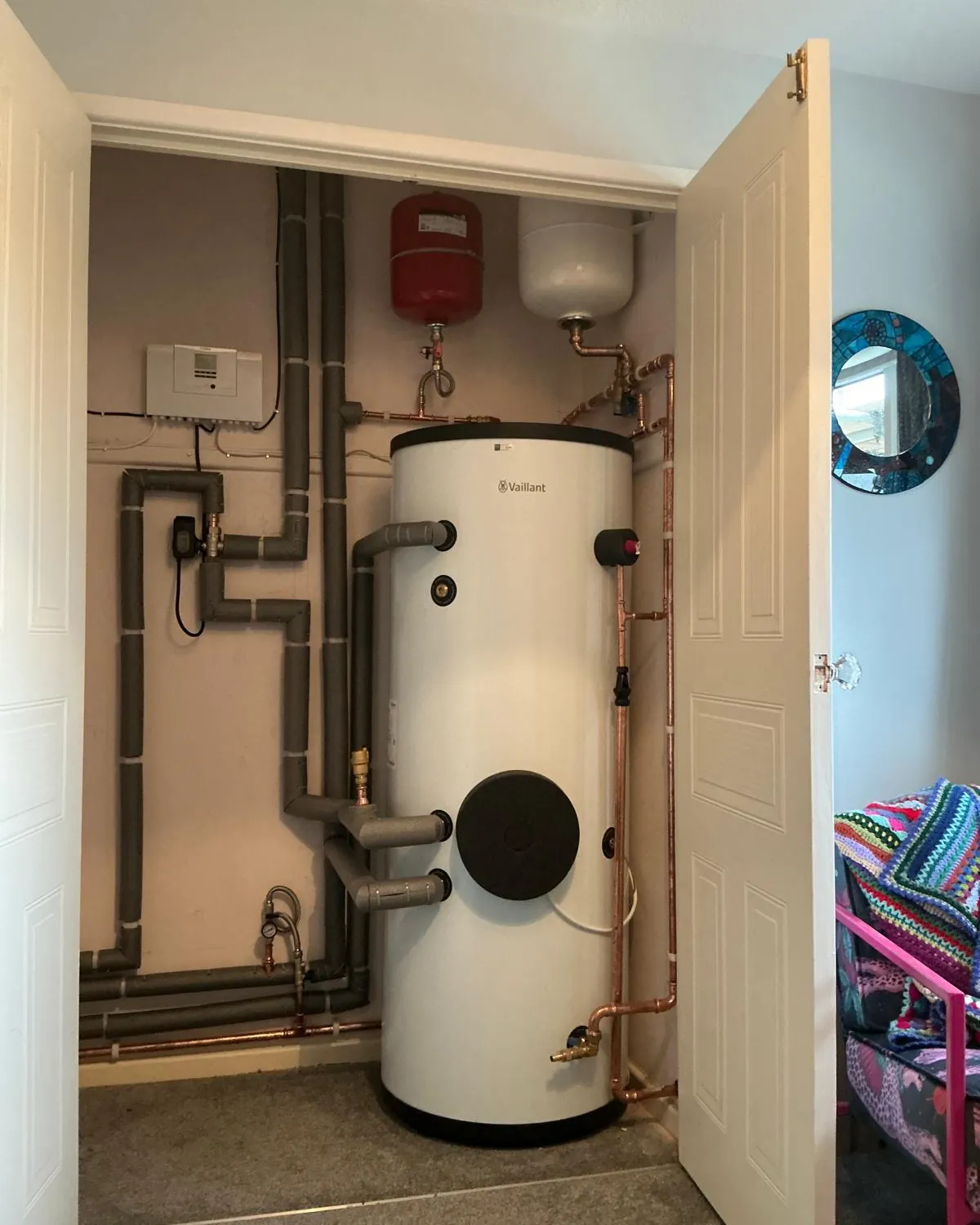
- A steady drip from the tundish pipe, usually outside or in the loft, which points to the expansion vessel or pressure relief valve
- Banging or knocking noises from the airing cupboard when the heating fires up
- Water pressure that's dropped off, leaving you with a trickle instead of a proper flow
- Hot water that runs too hot or won't get hot at all, even with the thermostat set right
- The cylinder itself feeling warm to the touch on the outside, which shouldn't happen if it's insulated properly
We see this every single week. Someone calls after weeks of a faint drip they'd assumed was just condensation, and by then the expansion vessel has failed completely. Older homes around Rotherham and Barnsley, many with cylinders fitted 10 or 15 years ago, are especially prone to worn valves as seals age and pressure settings drift.
Not sure if a noise is nothing or something? Fair question, and one we hear a lot. A single knock might just be air in the system, but repeated banging paired with pressure loss usually means a component needs replacing, not just bleeding.
Ignoring these signs doesn't make them go away. It just means the eventual repair costs more and takes longer.
Why Only Qualified Engineers Can Legally Repair Unvented Cylinders
Unvented cylinder work needs a specific competency, not just a general gas or heating background — see our Unvented Cylinder Installation page for the full detail on what that qualification covers and why. For a repair specifically, the risk isn't just working on the system, it's what gets missed or disturbed while fixing something else.
Our engineers work to Gas Safe standards — we're Gas Safe registered under number 584578, and a Heat Geek Assured Installer — which means the same attention to detail we bring to boiler and heat pump work carries over to cylinder repairs.
We check the expansion vessel, the pressure and temperature relief valves, and the tundish before we touch anything else. Skip that step and you might fix the symptom while missing the actual fault.
Unvented cylinder work here is carried out by a G3-qualified engineer, and we'll show you the certificate before we start. Ask any repairer for the same — if they hesitate, that's your answer.
We've seen homes where a previous repair left a safety valve disconnected. It looked fine for months, right up until it wasn't. That's the real reason qualification matters for a repair specifically — it's not just about fixing the fault in front of you, it's about not leaving something else worse than you found it.
When Your Cylinder Doesn't Need a Repair Yet
Not every drip or dial movement means your unvented cylinder is failing. These systems are built to self-regulate, and some of what looks alarming is just the cylinder doing exactly what it's designed to do.
A small trickle from the tundish pipe right after the cylinder heats up is usually normal. That's the temperature relief valve venting a bit of expansion, not a leak. Same goes for a pressure gauge that reads slightly different in winter versus summer — cold water expands less, so a small seasonal shift is expected.
A reset button that trips once after a power cut and then behaves fine afterward isn't a fault either. It's a safety feature doing its job.
- A slow drip from the tundish only during or right after heating
- Pressure gauge sitting anywhere between 1 and 3 bar during normal use
- A single reset after a power outage, with no repeat
- Slight humming from the immersion heater under load
That's normal, not a fault.
So when should you wait? If your cylinder is within its annual service window and none of the above signs are showing, there’s no need to rush a repair call. But if the tundish is dripping constantly, not just after heating, or the pressure keeps climbing past 3.5 bar on its own, that’s different, and it’s worth getting looked at properly. We’d rather tell you it’s fine today than book you a visit you didn’t need — that’s just how we work.
What to Expect During an Unvented Cylinder Repair Visit
You've booked the visit. Now what? Most homes we work on have the cylinder tucked in an airing cupboard or loft space, so the first few minutes are just getting access and checking the surroundings are safe to work in.
- We ask what you've noticed — no hot water, banging noise, water on the floor, whatever prompted the call.
- We check the pressure and temperature relief valves first, these fail more than anything else on the cylinder.
- We test the expansion vessel charge, a common cause of the pressure creeping too high.
- We inspect for any weeping or corrosion around fittings, especially on older units.
- We explain what we find in plain terms before touching anything else.
- We carry out the repair, testing hot water flow and pressure once it's done.
- We leave you with a working system and a clear rundown of what was fixed.
Nine times out of ten, it's a valve or the expansion vessel, not the cylinder itself. That's good news — it's usually a straightforward fix rather than a full replacement.
If the cylinder checks out and the fault is somewhere else in the system, such as the boiler, a pump, a zone valve or the controls, our heating system repair service across Rotherham and Barnsley picks it up from there.
Picture this: no hot water on a cold morning, a faint knocking sound from the airing cupboard the night before. That's a classic pattern we hear about weekly, and it's exactly the kind of fault this visit is built to catch early.
As a Heat Geek Assured Installer, our engineers work to a consistent standard on every job, so the checks you get in Rotherham are the same ones we'd run anywhere we work.
Protecting Unvented Cylinders in Older, Hard-Water Homes
A lot of the homes we work on around Rotherham and the Dearne Valley date back to the early 1900s colliery housing boom. Solid brick, original pipework in some cases, and cylinders often bolted into cupboards that were never designed for them. Older systems like this put extra strain on unvented cylinder parts. Pressure vessels, expansion valves, and seals all wear faster when the surrounding pipework is decades old and slightly out of spec.
The water round here sits on the harder side, and that matters. Hard water leaves limescale behind inside heat exchangers and around valve seats. Over time that buildup stops valves seating properly — we see it constantly on service visits. A cylinder that's fine at commissioning can develop scale-related faults five or six years later, quietly, without any obvious warning sign at first.
- Reduced hot water pressure that used to feel strong
- A tank that takes longer to reheat than it used to
- Small drips from the tundish that weren't there before
- A pressure gauge sitting outside its normal range
- Odd knocking or rumbling from the airing cupboard
None of these mean the cylinder's finished. But they're the kind of thing worth catching early, before scale turns a simple valve clean into a full component swap. If your home's older, or you know your kettle furs up fast, that's your cylinder telling the same story on the inside.
What our customers say
New water tank
New water tank fitted efficiently and well. I wasn’t looking forward to the mess but there wasn’t any at all. Who knew that there would be benefits to having a new tank, apart from it not leaking? The water stays hotter much longer, the power shower has more power and the hot water runs much faster.
Leak in the bathroom
I Phoned about a leak I was having and from phoning to the job been finished was around 2 hour! Which was more than I expected when I didnt ring until mid afternoon. Chris was very polite and showed me the issue and then showed me his finished work which wasnt easy with only a little space to work with. All in all I was really happy from start to finish and will be using him again.
Where we work on unvented cylinders
Unvented cylinder work is on our standard rate across Rotherham (S60 to S66), Barnsley (S70 to S75), the Dearne Valley, Doncaster (DN1, DN2, DN4, DN5 and DN6) and north and east Sheffield (S4, S5, S9 and S35). Chesterfield, Worksop, Wakefield, Pontefract and the rest of Sheffield outside the city centre are on our Band A rate, which is the same work with 10% added for the travel. Every postcode, and the few we don’t cover, is on our rates and coverage areas page.
Standard rate
- S60
- S61
- S62
- S63
- S64
- S65
- S66
- S70
- S71
- S72
- S73
- S74
- S75
- DN1
- DN2
- DN4
- DN5
- DN6
- S4
- S5
- S9
- S35
- DN12
- WF9
Band A: same work, 10% added for travel
- S7
- S8
- S10
- S11
- S12
- S13
- S14
- S17
- S20
- S21
- S26
- S36
- S25
- S18
- S32
- S33
- S40
- S41
- S42
- S43
- S44
- S80
- S81
- NG20
- DN10
- DN11
- DN22
- DN3
- DN7
- DN8
- DN9
- DN21
- WF1
- WF2
- WF3
- WF4
- WF5
- WF6
- WF7
- WF8
- WF10
- WF11
- HD8
- HD9
Related services
Frequently Asked Questions
How fast can you get to me if my cylinder is leaking?
Our engineers work Monday to Friday, 8am to 4pm. Ring during office hours and we'll do our best to get to you the same day — there's a £30 same-day charge on top of the repair rate — otherwise it's first thing the next working day. We don't offer out-of-hours or emergency callouts. If water is actively running, turn the mains stopcock off before you call. Older homes around Rotherham and Barnsley often have cylinders fitted 10 or 15 years ago, so worn valves are a common cause, and the sooner we look the smaller the fix usually is.
What does an unvented cylinder repair cost?
£114 including VAT at standard rate and £132 in Band A — the same rate as a boiler repair. That covers the first hour, then we charge in 15-minute increments. Parts are quoted separately and we tell you the figure before ordering anything. Every visit comes with a 4-hour slot (8am to 12pm, 10am to 2pm or 12pm to 4pm) as standard. A set appointment time, or same-day attendance, adds £30 each on top of that.
Can I fix an unvented cylinder problem myself?
No, this work legally needs a properly trained and competent engineer. Unvented cylinders are sealed and pressurised, so a mistake during a DIY fix can create a real safety risk, not just a leak. Building regulations exist for this exact reason. Before booking anyone, ask what qualifies them for unvented cylinder work specifically, not just general heating experience.
Is a dripping tundish always a sign of a fault?
Not always — a slow drip right after the cylinder heats up is usually normal venting from the temperature relief valve. It's the constant drip, one that happens even when the system isn't heating, that points to a real problem. Pressure sitting between 1 and 3 bar during normal use is also fine. If the tundish keeps dripping non-stop or pressure climbs past 3.5 bar on its own, that's the point to get it checked properly.
Why do older properties round here seem to have more cylinder issues?
Many homes around Rotherham and Barnsley had their unvented cylinders fitted 10 to 15 years ago, and seals and valves wear down over that time. Pressure settings drift, expansion vessels lose their charge, and small faults get missed until a drip becomes a real leak. We see this pattern every week — someone assumes a faint drip is just condensation, and by the time they call the expansion vessel has already failed completely.
Talk to the office team
Office open Monday to Friday 8am to 6pm, and Saturday 8am to 12pm. Tell us what's going on and we'll book the right visit, in a weekday 4-hour slot: 8am to 12pm, 10am to 2pm or 12pm to 4pm.