
Unvented Cylinder Replacement Across Rotherham and Barnsley: Safe, Certified Hot Water
Unvented cylinder replacement across Rotherham, Barnsley and Doncaster. G3-qualified, properly commissioned. We'll tell you if a repair would do instead.
- Gas Safe registered 584578
- Heat Geek Assured
- 100+ 5-Star reviews on Google
- In the trade since 2009
- DBS checked
Signs You Need Unvented Cylinder Replacement, Not Just a Repair
Quick summary: not every fault means the whole unit has to come out. Sometimes it's just a valve, a seal, or a setting that's drifted out of range. But there's a real difference between a cylinder that's struggling and one that's actually failing, and knowing which one you've got can save you a fair bit of money and hassle.
So what tips a job from a repair into a replacement? Age plays a part. Most unvented cylinders are built to last well over a decade, but the internal components, the expansion vessel, the immersion heaters, the safety valves, all wear at different rates. Once several parts start failing around the same time, patching one usually just means the next one fails a month later.
- Water pressure that keeps dropping even after the expansion vessel has been recharged
- Rust-coloured water or a metallic smell coming from the hot taps
- The tank banging or knocking as it heats up
- Water leaking from the cylinder casing itself, not just a fitting
- Repeated call-outs for the same fault within a short space of time
If you're only seeing one of these, don't panic. That's usually a straightforward repair, and our team handles Unvented Cylinder Repairs and Unvented Cylinder Service work regularly for exactly this reason. It's when two or three of these show up together that we start talking about replacement instead.
Here's the thing we tell people straight: if your cylinder is under ten years old and it's only thrown one fault, get it looked at before assuming the worst. We see this every single week, someone convinced they need a whole new tank when it's actually a forty-minute fix.
When a Repair or Service Solves the Problem Instead
Not every cylinder problem means a new cylinder. Usually it's the same handful of culprits, a faulty expansion vessel, a stuck valve, or a discharge pipe simply doing its job after a temperature spike. If your cylinder is under ten years old and the tank itself hasn't failed, there's a good chance a service visit sorts it out.
For the detail on what counts as a normal reading versus an actual fault, tundish drip patterns, pressure ranges, valve behaviour, see Unvented Cylinder Repairs, which covers that diagnostic ground properly. The short version for replacement purposes: a cylinder under ten years old with no visible corrosion, dents, or rust staining is very rarely a replacement job, whatever else is going on with it.
If that's where you are, Unvented Cylinder Service or Unvented Cylinder Repairs is probably your answer, not a full swap. We'd rather send an engineer out to fix a valve than sell you a cylinder you don't need yet.
But there's a line. If the tank body itself has failed, if you can see corrosion through the outer casing, or if the vessel has a genuine crack, no service visit fixes that. That's a structural fault, not a component fault, and it puts you back in replacement territory. A good engineer will tell you which side of that line you're on before doing any work, not after.
Why So Many Homes Round Here Have Unvented Cylinders
A lot of the terraced houses near Rotherham and Barnsley town centres were built with tight lofts. There's simply no room up there for a cold water tank and a header tank sitting side by side. So when these homes had their old gravity-fed systems ripped out, an unvented cylinder was the practical answer, no tank in the loft, no risk of it freezing in a cold snap, just mains-fed hot water stored under pressure.
We see this pattern all the time on service calls. The airing cupboard's gone, the loft's boarded for storage, and the old tank's long been replaced.
Newer estates built on former colliery land around the Dearne Valley tell a different story. These homes went up with decent mains pressure already in place, so builders fitted unvented cylinders from day one instead of the older gravity systems. Ever wonder why your shower stays strong even when someone's running the kitchen tap downstairs? That's an unvented cylinder doing exactly what it's designed to do.
And it's not just new builds. Homeowners adding a loft conversion or a second bathroom often switch to unvented for the same reason, strong flow to two bathrooms at once without a header tank losing pressure. As Heat Geek Assured installers, our team spots this setup constantly, and it usually means the cylinder is doing more work than the house was originally designed for.
What Happens During a Professional Cylinder Replacement
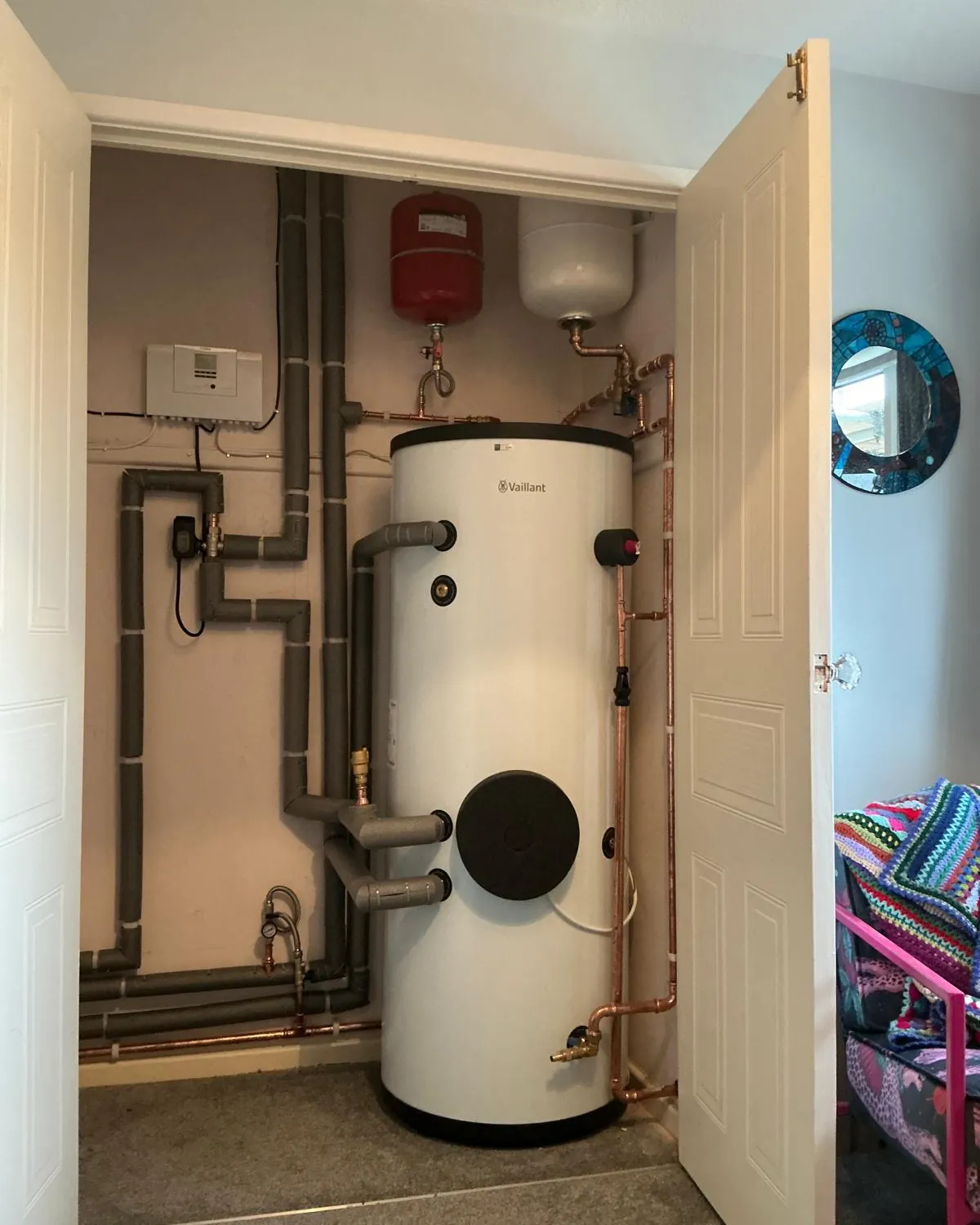
So what actually happens on the day? A lot of homeowners picture a chaotic mess of pipework and hours of disruption. It isn't that. A proper unvented cylinder replacement follows a clear sequence, and a Gas Safe registered engineer should walk you through each stage before touching anything.
- Isolate the water supply and drain the existing cylinder fully before any disconnection begins.
- Disconnect the old unit and check the surrounding pipework, valves, and expansion vessel for wear or corrosion.
- Remove the failed cylinder and prepare the space, including checking the tundish and discharge pipe route.
- Fit the new unvented cylinder, connect the expansion vessel, and install the required safety valves to current standards.
- Pressure test the whole system and check every joint for leaks under load, not just at rest.
- Set the thermostat and commissioning parameters, then run the system through a full heat cycle.
- Fill out the commissioning paperwork and explain the controls before we leave.
That last step matters more than people think. Many older properties round here still have airing cupboards built for smaller tanks, so pipework often needs adjusting to fit a modern unvented cylinder properly. We see this every single week on terraced homes near town centres. Skipping the fit-check is how you end up with a cylinder that technically works but sits awkwardly, straining connections over time.
A full replacement usually takes a working day, sometimes less. And because we're Heat Geek Assured installers, system design isn't an afterthought, it's checked against your actual heating setup before installation, not just swapped like for like.
What it costs. Replacement is quoted after we've seen the cylinder and checked your mains pressure, because the size and the pipework both affect the job. Annual servicing afterwards is £174 including VAT alongside a boiler service, or included in the £240 heat pump service — we don't service a cylinder on its own. Full prices are on our rates page.
G3 Qualification: Why Not Every Engineer Can Do This Job
Gas Safe registration covers boilers and gas appliances, but it doesn't automatically cover unvented cylinders, working on one needs a separate qualification called G3 (see our Unvented Cylinder Installation page for the full detail on why). For a replacement specifically, that qualification is what confirms the new unit is set up correctly for your system, not just fitted where the old one used to sit:
- Confirms the expansion vessel is correctly sized and charged for your cylinder's capacity
- Sets and tests the temperature and pressure relief valves before handover
- Checks the discharge pipework routes safely away from the property
- Verifies the cylinder is compatible with your incoming mains pressure
We're Heat Geek Assured installers, and G3 work is something our team takes seriously every single time, not just when someone's watching.
Your replacement will be carried out by a G3-qualified engineer, and we'll show you the certificate before we start. Our team is also Gas Safe registered (No. 584578), so you can check us on the register before we come out.
So when you're asking a company about unvented cylinder replacement, ask them straight: do you hold a current G3 qualification for this specific job? If they hesitate, that's your answer.
What our customers say
New water tank
New water tank fitted efficiently and well. I wasn’t looking forward to the mess but there wasn’t any at all. Who knew that there would be benefits to having a new tank, apart from it not leaking? The water stays hotter much longer, the power shower has more power and the hot water runs much faster.
Replacement tvr valve and replacement tvr head
I recently had a replacement tvr valve fitted also replacement tvr head, excellent prompt service, extremely happy with work carried out I would highly recommend Uberheats
Where we work on unvented cylinders
Unvented cylinder work is on our standard rate across Rotherham (S60 to S66), Barnsley (S70 to S75), the Dearne Valley, Doncaster (DN1, DN2, DN4, DN5 and DN6) and north and east Sheffield (S4, S5, S9 and S35). Chesterfield, Worksop, Wakefield, Pontefract and the rest of Sheffield outside the city centre are on our Band A rate, which is the same work with 10% added for the travel. Every postcode, and the few we don’t cover, is on our rates and coverage areas page.
Standard rate
- S60
- S61
- S62
- S63
- S64
- S65
- S66
- S70
- S71
- S72
- S73
- S74
- S75
- DN1
- DN2
- DN4
- DN5
- DN6
- S4
- S5
- S9
- S35
- DN12
- WF9
Band A: same work, 10% added for travel
- S7
- S8
- S10
- S11
- S12
- S13
- S14
- S17
- S20
- S21
- S26
- S36
- S25
- S18
- S32
- S33
- S40
- S41
- S42
- S43
- S44
- S80
- S81
- NG20
- DN10
- DN11
- DN22
- DN3
- DN7
- DN8
- DN9
- DN21
- WF1
- WF2
- WF3
- WF4
- WF5
- WF6
- WF7
- WF8
- WF10
- WF11
- HD8
- HD9
Related services
Frequently Asked Questions
Will I be without hot water while my cylinder is being replaced?
Yes, for the duration of the job, since the system has to be drained before the old cylinder comes out. Most straightforward replacements are finished within a working day, so you're typically back to normal hot water by the evening. We'll confirm the expected timescale before work starts, and if your pipework needs adjusting for a different-sized cylinder we'll flag that upfront rather than partway through.
Why do so many homes round here have unvented cylinders?
Many terraced houses near town centres have tight lofts with no room for a cold water tank and header tank. Unvented cylinders solved that problem — no tank in the loft, no freezing risk, just mains-fed hot water stored under pressure. Newer homes built on former colliery land around Rotherham and the Dearne Valley often had them fitted from day one, thanks to strong mains pressure already in place.
How do I know if my cylinder needs repairing or replacing?
One fault on its own, like a chattering valve or a dripping discharge pipe, usually points to a repair rather than a replacement. It's when two or three problems show up together — dropping pressure, rusty water, banging noises — that we start talking replacement. If your cylinder is under ten years old and has only thrown one fault, get it checked before assuming the worst. Often it's a forty-minute fix.
What are the warning signs my unvented cylinder is failing?
Watch for water pressure that keeps dropping even after recharging, rust-coloured water, or a banging noise as the tank heats up. Leaking from the cylinder casing itself, not just a fitting, is another red flag. Repeated call-outs for the same fault in a short time also suggests the unit is struggling. Any one of these on its own is usually manageable, but several together often mean replacement time.
Are older houses suited to unvented cylinders?
Yes, and it often works better than people expect. Older properties around Rotherham and Barnsley frequently have airing cupboards built for smaller tanks, so pipework sometimes needs adjusting during installation. Once fitted, unvented cylinders give strong, steady flow to bathrooms without a header tank losing pressure, which suits homes with loft conversions or a second bathroom added over the years.
Talk to the office team
Office open Monday to Friday 8am to 6pm, and Saturday 8am to 12pm. Tell us what's going on and we'll book the right visit, in a weekday 4-hour slot: 8am to 12pm, 10am to 2pm or 12pm to 4pm.