
Air Source Heat Pump Repair in Rotherham and Barnsley: Get Reliable Heat Restored
Air source heat pump repairs from £240 inc VAT across Rotherham and Barnsley. F-Gas certified diagnosis of refrigerant and electrical faults.
Diagnostics from£240first hour, including VAT · Band A £264
- Gas Safe registered 584578
- Heat Geek Assured
- 100+ 5-Star reviews on Google
- In the trade since 2009
- DBS checked
First — is it actually a fault?
Before you book anything, it's worth knowing what normal winter behaviour looks like, because we get calls every week about things that aren't faults at all.
Frost on the outdoor unit is normal. Heat pumps pull heat from outside air, and in cold, damp conditions that process frosts the coil. The unit runs a defrost cycle to clear it, briefly reversing before switching back to heating. You might see steam rising off the unit or a short dip in output. That's the system working, not failing.
We're in the Dearne valley, which is low-lying and damp, so outdoor units around here pick up frost faster than they would on higher, drier ground. It happens a lot through January and February.
Longer run times in winter are normal too. The colder the air outside, the harder the unit works to hit your target temperature, so it runs longer. That's physics, not failure.
- Frost that melts within 20 to 30 minutes during a defrost cycle — no action needed
- Longer daily run times on sub-zero days compared with milder ones
- A brief drop in output right as defrost kicks in, then normal service resumes
- Airflow blocked by leaves, bins or a fence panel too close — clear a gap and give it room
When it is a fault: ice that builds up and never clears, ice spreading up the pipework rather than sitting on the coil, a unit running constantly with no let-up even on a mild afternoon, or a compressor labouring and cycling in short bursts. A stuck defrost cycle points to a faulty valve or low refrigerant charge, not the weather.
Signs you need a repair rather than a service
Quick Summary: Noises, tripped electrics and ice that won't clear are repair territory. Gradually rising bills with no other symptom is usually a service overdue.
You don't need to be an engineer to spot trouble. Most homeowners notice it through sound first — a grinding or clicking noise from the outdoor unit is never normal.
- Grinding, clicking or a new rattle from the outdoor unit
- Ice that doesn't clear after the defrost cycle, or spreads up the pipework
- The unit short cycles, switching on and off every few minutes
- It's tripped the electrics more than once
- Water pooling near the outdoor unit or the indoor cylinder
- The house won't hold heat even after checking airflow and settings
It usually comes down to one of two things: a refrigerant issue or a fault in the defrost cycle. We hear about this most after a hard frost.
If the only symptom is a bill that's crept up over months, that's more likely a service overdue than a fault — our heat pump service page covers that.
Why this isn't a DIY job, or a general handyman job
An air source heat pump isn't a boiler with a fan bolted on. It's a sealed refrigerant circuit wired into your home's electrical supply, and both sides carry real risk if handled wrong.
The refrigerant runs under pressure. Crack a fitting without the right gauges and recovery kit and you're not just wasting gas, you're releasing something that shouldn't be vented into the air. F-Gas handling regulations exist for a reason, and we're F-Gas certified — that's not optional for this work.
Then there's the electrical side. Heat pumps draw on dedicated circuits, often with isolators, RCDs, and sometimes a separate consumer unit connection depending on how the system was installed. Get the wiring wrong and you risk tripping the whole house, or worse.
- Refrigerant leaks need proper detection equipment, not guesswork
- Compressor faults often show electrical symptoms before mechanical ones
- Isolator switches and RCD protection must be checked, not assumed safe
- Outdoor unit corrosion can hide wiring damage until load increases
If you're not confident opening the outdoor casing, don't.
What a repair costs
Diagnosis and repair is £240 including VAT at standard rate and £264 in Band A, covering the first hour, then charged in 15-minute increments. Same-day attendance adds £30 where we can fit you in, as does a set appointment time instead of a 4-hour slot (8am to 12pm, 10am to 2pm or 12pm to 4pm).
Parts are quoted separately once we know what's actually wrong, and we tell you the figure before ordering anything. Refrigerant, if the system needs recharging, is quoted separately too.
We don't charge a diagnostic fee on top of the repair rate — the first hour covers finding the fault, and if we can fix it inside that hour, that's what you pay.
Check which band your postcode falls into on our rates page.
What happens on a repair visit
Our engineers work Monday to Friday, 8am to 4pm. Ring during office hours and we'll do our best to get to you the same day; otherwise it's first thing the next working day. We don't offer out-of-hours or emergency callouts.
- We listen to your description of the fault and check the system history
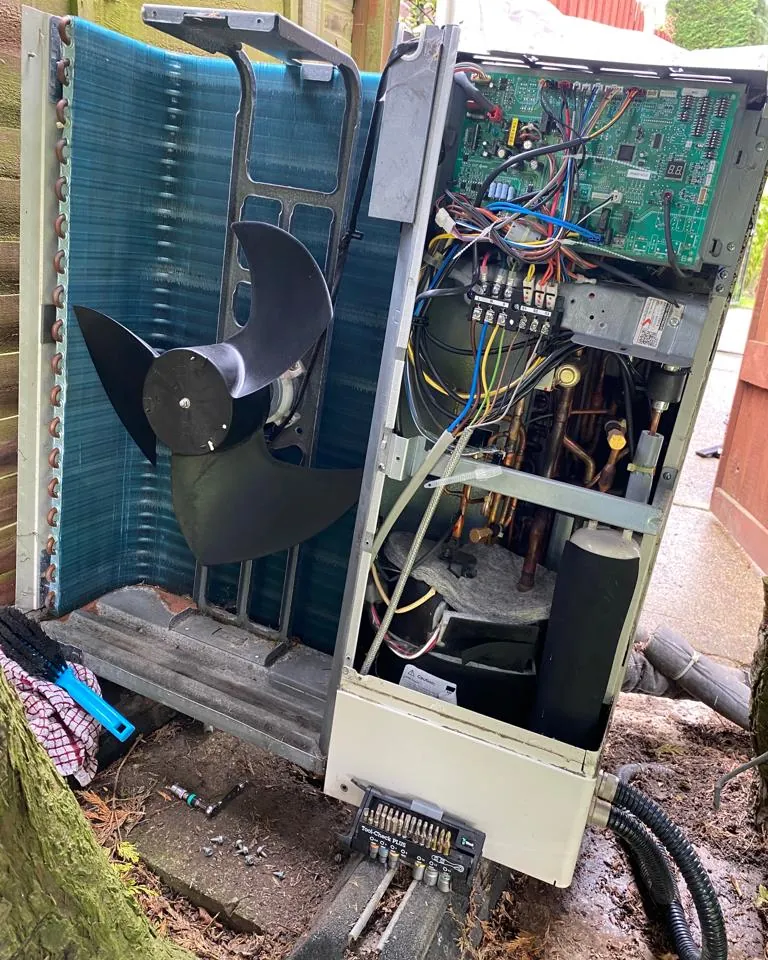
- Inspect the outdoor unit for ice buildup, fan issues or blocked airflow
- Test refrigerant pressures, electrical readings and control settings
- Explain what's wrong in plain terms before any work starts
- Carry out the repair and run the system to confirm it's holding heat
We won't start swapping parts on a hunch. Checking flow temperatures and system pressures first is what stops you paying twice — once for the wrong fix, then again for the right one.
Some faults are sorted in under an hour. Others need a part ordered, and we'll tell you straight away which one you're dealing with.
Before we leave, we run the heat pump through a full cycle. We want to see it heating properly, not just switching on.
What our customers say
What a brilliant firm!! Had a failed heating system (Air Source Heat Pumps) and found Chris on line. His web site allowed the booking of a visit with up front details of likely costs. There was only one day between contact and visit and the response to my initial text re the problem was immediate, really reassuring. Extremely fair pricing with no outlandish prices for spare parts. Text sent out to say Chris on his way and you can also follow his arrival on your phone. In this day and age real service!
Air to water heat pump service
Chris was delayed by a previous job but did let me know he would be late. He was courteous and efficient bringing everything he needed. The job was done quickly and he even fixed the loft ladder which I was unable to use.
Areas we cover
Most of our heat pump and system design work is close to home. Rotherham (S60 to S66), Barnsley (S70 to S75), Doncaster (DN1, DN2, DN4, DN5 and DN6), north and east Sheffield (S4, S5, S9 and S35) and Hemsworth and South Elmsall (WF9) are all on our standard rate. Further out, Chesterfield and North Derbyshire (S40 to S44), Worksop (S80 and S81), Wakefield (WF1 to WF5), the Five Towns, and Holmfirth and Denby Dale (HD8 and HD9) are on our Band A rate, 10% higher for the travel. We don’t cover Sheffield city centre (S1, S2, S3 and S6), Dewsbury and Batley, Huddersfield itself, or Leeds.
Standard rate
- S60
- S61
- S62
- S63
- S64
- S65
- S66
- S70
- S71
- S72
- S73
- S74
- S75
- DN1
- DN2
- DN4
- DN5
- DN6
- S4
- S5
- S9
- S35
- WF9
- DN12
Band A: same work, 10% added for travel
- S7
- S8
- S10
- S11
- S12
- S13
- S14
- S17
- S20
- S21
- S26
- S36
- S25
- S18
- S32
- S33
- S40
- S41
- S42
- S43
- S44
- S80
- S81
- NG20
- DN10
- DN11
- DN22
- DN3
- DN7
- DN8
- DN9
- DN21
- WF1
- WF2
- WF3
- WF4
- WF5
- WF6
- WF7
- WF8
- WF10
- WF11
- HD8
- HD9
Related services
Frequently Asked Questions
How soon should I book a repair once I notice a problem?
As soon as you spot a warning sign. Grinding noises, frost that won't clear, or a unit running non-stop are early signals of a refrigerant or electrical fault, and catching them early usually means a smaller, simpler fix. Leave it too long and a small refrigerant leak or failing component can turn into compressor failure, which is a much bigger job.
How much does a heat pump repair cost?
£240 including VAT at standard rate and £264 in Band A, covering the first hour, then 15-minute increments after that. There's no separate diagnostic fee — the first hour covers finding the fault, and if we fix it inside that hour, that's what you pay. Parts and refrigerant are quoted separately once we know what's wrong.
Why does my heat pump ice up so often around here?
The Dearne valley is low-lying and damp, and that extra moisture makes outdoor units frost faster than they would on higher, drier ground. Some frost during a defrost cycle is completely normal, especially through January and February, and it should clear within 20 to 30 minutes on its own. If ice builds up and never clears, or spreads up the pipework, that points to a stuck defrost cycle or low refrigerant charge.
Is it safe to keep running my heat pump if it's making a new noise?
It isn't worth the risk. A grinding or clicking noise from the outdoor unit is never normal, and it often traces back to a refrigerant issue or a failing electrical component — both of which get worse if left running. Compressor faults especially tend to show up as noise or electrical symptoms before the unit fails completely. Switching it off and getting it checked protects you from turning a small fault into a much bigger repair.
Can I fix a heat pump fault myself?
No. The refrigerant circuit runs under pressure and is covered by F-Gas handling regulations, so cracking a fitting without the right gauges and recovery kit can release refrigerant that shouldn't be vented. The electrical side carries similar risk, with dedicated circuits, isolators and RCDs that need checking properly. Getting it wrong risks tripping your whole house or damaging the unit further.
Talk to the office team
Office open Monday to Friday 8am to 6pm, and Saturday 8am to 12pm. Tell us what's going on and we'll book the right visit, in a weekday 4-hour slot: 8am to 12pm, 10am to 2pm or 12pm to 4pm.