
Central Heating Power Flush in Rotherham and Barnsley: Clear the Sludge, Get Even Heat Back
Central heating power flush £750 inc VAT, covering up to 10 radiators. Clears sludge, restores even heat. Rotherham, Barnsley and Doncaster.
Power flush from£750up to 10 radiators, including VAT · Band A £780
- Gas Safe registered 584578
- Heat Geek Assured
- 100+ 5-Star reviews on Google
- In the trade since 2009
- DBS checked
What it costs
Three options, all flat prices covering up to 10 radiators and chemicals, which suits most homes:
| Standard | Band A | |
|---|---|---|
| Mains flush | £390 | £420 |
| Magnetic flush (MagnaCleanse) | £510 | £540 |
| Full power flush with MagnaCleanse | £750 | £780 |
If your system has more than ten radiators we quote the extra ones separately, and you'll know the figure before we start rather than after.
Check which rate band your postcode falls into on our rates page.
Which one do you need?
Honest answer: usually the full power flush, but not always, and it's worth knowing why.
A mains flush uses mains water pressure to push through the system. Quickest and cheapest, and it's fine on a system that's basically healthy — a newer system being freshened up, or one where you're changing a few radiators and want the debris out.
A magnetic flush circulates the MagnaCleanse unit through the system, pulling ferrous sludge out magnetically as it goes. Good where the problem is specifically magnetite — black iron oxide from cast iron radiators — and where the system doesn't need the mechanical force of a full flush.
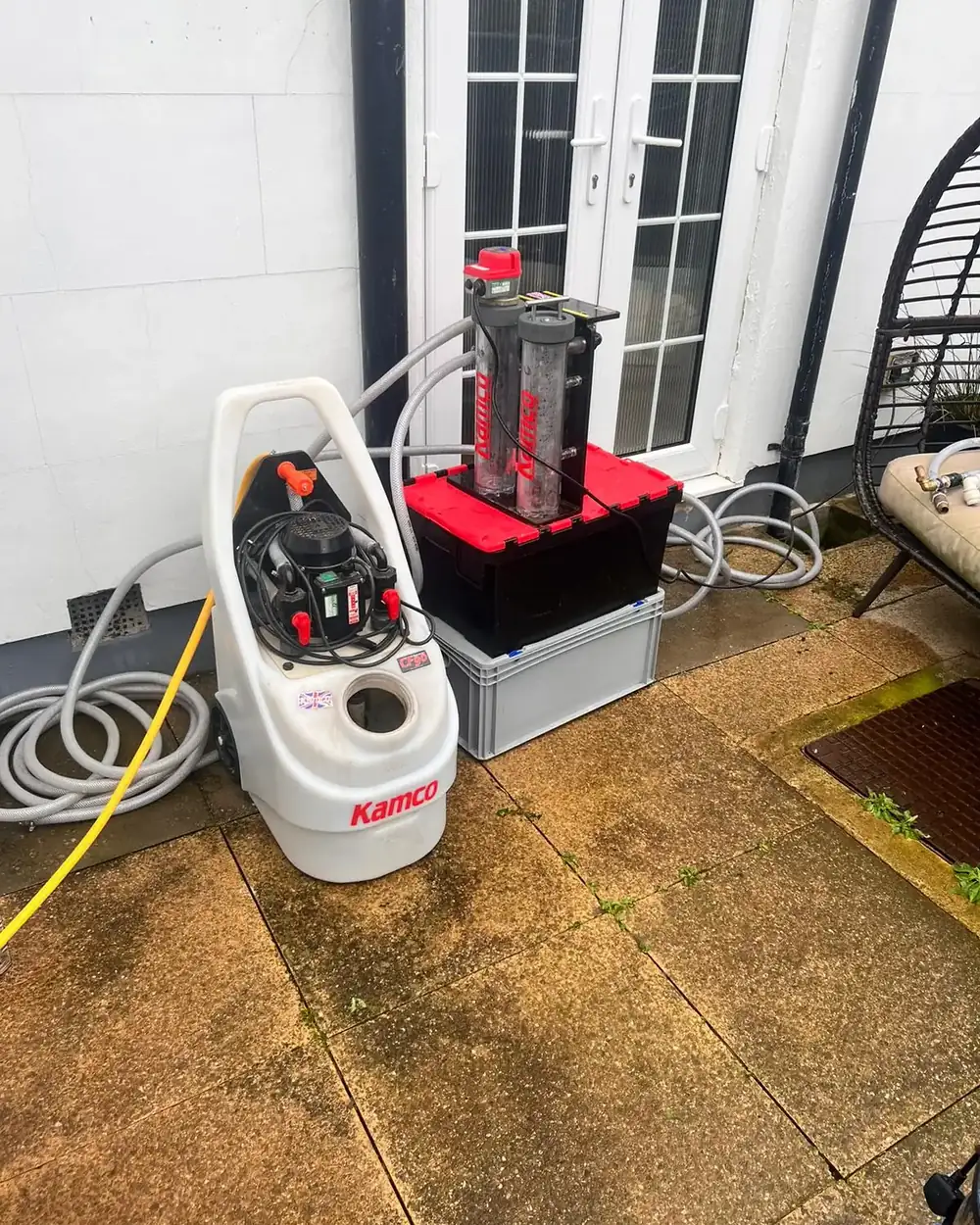
A full power flush connects a pump that forces high-flow, low-pressure water through every radiator and pipe, with chemicals first to break the sludge down. We run the MagnaCleanse unit alongside as standard, so you get the chemical and mechanical clean plus magnetic filtration in one visit. That combination clears more than either method alone, and it's what we'd recommend on most older systems.
We assess flow, check for cold spots and test the system water before deciding. If the cheaper option will do the job, we'll say so.
Cold radiators and noisy pipes: reading the warning signs
Quick Summary: Cold spots on radiators, gurgling pipework, and a boiler that keeps switching itself off all point to the same culprit — sludge blocking water flow. Catch it early and you save a much bigger bill later.
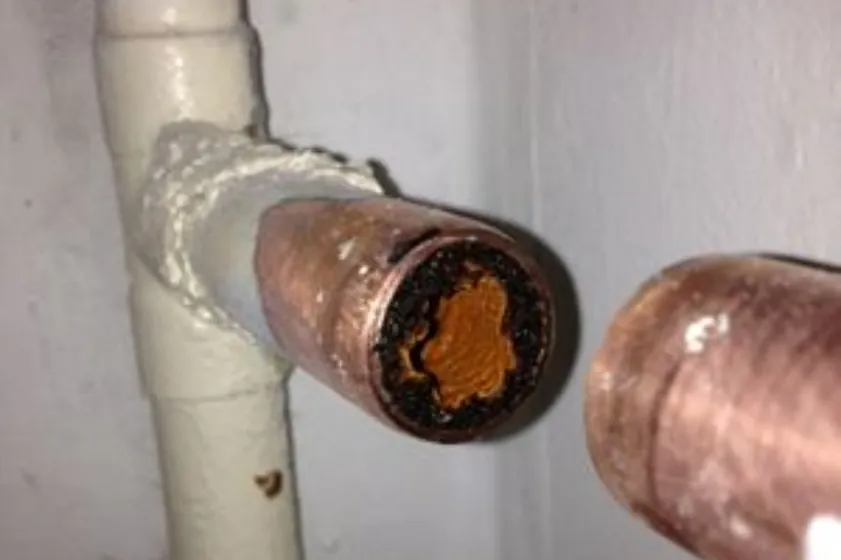
Try this: rest your hand flat across a radiator that's supposedly on full blast. Warm at the top, cold at the bottom? That's not a radiator fault, it's sludge sitting at the base of the panel, stopping hot water circulating the way it should.
Often we hear the problem before we see it. A banging or gurgling from the pipework, right when the heating kicks in, usually means trapped air or debris moving through the system. People describe it as a kettle boiling inside the wall. Not dangerous by itself, but it's your system telling you something's off.
- Radiators needing bleeding every few weeks instead of once a season
- Boiler switching on and off more often than it used to — short cycling
- Discoloured water when you bleed a radiator, often brown or black
- Rooms that used to heat fast now taking twice as long
- Higher gas bills with no change in how you use the heating
Older properties around Rotherham and Barnsley, with cast iron radiators and original 1970s pipework, show these signs first — sludge has had decades to build up. One cold radiator might just be a trapped air pocket. Three or four cold radiators plus a noisy boiler is a system-wide flow problem.
When you don't need a flush at all
Not every cold radiator means a flush. Sometimes it's trapped air, and a quick bleed sorts it in minutes.
The trick is where the cold sits. Air rises, sludge settles. Cold at the top with a hiss when you bleed it is air. Cold at the bottom, or patchy cold spots across the panel, is sludge. One's a five-minute job with a radiator key; the other needs proper equipment.
- One radiator cold at the top only, others heating normally
- The system is new, or was flushed within the last year or two
- No banging or gurgling from the boiler or pipework
- Hot water and heating both come up to temperature at a normal speed
- No history of black or rusty water when radiators are drained
If your system ticks those boxes, save your money and bleed the radiator first. We'd rather tell you that than send someone out for a job a radiator key can handle.
But if several radiators are cold at the bottom, or the boiler's making a noise it never used to, the sludge has likely spread through the whole system and bleeding won't touch it.
Not sure it's sludge at all? If the heating has stopped working altogether, that's a heating system repair, not a flush. If it's running but just not as well as it used to, a heating system maintenance visit in Rotherham and Barnsley is the place to start.
What happens on the day
Not just running the taps and hoping. We're Gas Safe registered, and every connection to your boiler gets checked before anything switches on.
- We isolate the boiler and connect the flush unit, with MagnaCleanse incorporated, usually through the pump or a radiator valve
- Cleaning chemicals go in and circulate to loosen built-up sludge and limescale
- Each radiator is isolated one at a time, so the flow hits it hard and pushes debris toward the nearest drain point
- We reverse the flow on stubborn radiators, dislodging sludge settled on the far side
- A neutralising chemical goes in at the end to protect the system from the flush chemicals themselves
- Fresh water refills the system, and we check pressure, bleed the radiators and confirm the boiler fires correctly
- A magnetic filter check confirms the system has run clear before we finish
Nine times out of ten the water coming out in the first hour looks like weak tea. By the end it should run close to clear.
A flush on a typical semi with six to eight radiators takes several hours. Older homes with cast iron radiators or narrow-bore pipework need longer, since sludge packs tighter. If a radiator's completely blocked we'll sometimes pull it off the wall for a more direct flush — that's a judgment call on site.
Our engineers work Monday to Friday, 8am to 4pm, and a flush is a full-session job, so it's booked in rather than fitted around other work.
Older systems need checking before we connect anything
A lot of the housing around here went up before central heating was standard, and plenty of streets still have pipework from the 1960s and 70s behind the plaster.
That matters. Older systems often mix metals — cast iron radiators next to copper pipe next to a galvanised section someone added decades back. Sludge and rust build up differently in each, and a flush that's too aggressive can dislodge more than it should.
So we check the whole system before we start, not just the boiler: weak joints, thin pipe walls, radiators corroded from the inside. Most of the time it's fine and the system just needed clearing. But if a joint's already on its last legs, a flush can expose that faster than it would have shown up on its own.
Things to watch for in the days after a flush on an older system:
- Radiators still warm at the top but cold at the bottom
- Small drips at radiator valves or pipe joints within a day or two
- Pressure dropping faster than normal on the boiler gauge
- Water running discoloured from a bleed valve weeks later
None of that means the flush went wrong — it usually means an old joint was already weak. Older pipework isn't a reason to skip a flush, it's a reason to have someone who knows what they're looking at do it.
Timing matters more than the price
A flush before a boiler swap protects the new unit — and most manufacturers require the system to be cleaned for the warranty to stand. A flush on a struggling old boiler might just buy you a season.
If you're weighing up a new boiler anyway, it's worth having that conversation first. We'd rather flush a system that's about to be paired with a new boiler than flush one that's about to be replaced.
What our customers say
Boiler service
Chris fitted a new boiler for me last year. Excellent professional service. His company then contact you annually with a service reminder. This has just been carried out in his usual cheerful, efficient way. Thankyou.
Boiler service
I always turn to Chris for any problems I have with plumbing, etc, he services my boiler every year and I look forward to seeing him next year, can’t recommend him enough
Our area
We flush, repair and maintain heating systems across Rotherham, the Dearne Valley and Barnsley (S60 to S66 and S70 to S75), Doncaster (DN1, DN2, DN4, DN5 and DN6) and north and east Sheffield (S4, S5, S9 and S35), all at our standard rate. Further out, Chesterfield, Worksop, Wakefield, Pontefract and Castleford, and the rest of Sheffield outside the city centre, are the same work on our Band A rate, 10% higher for the travel. Ring 07851 911574 with your postcode and we’ll tell you which applies.
Standard rate
- S60
- S61
- S62
- S63
- S64
- S65
- S66
- S70
- S71
- S72
- S73
- S74
- S75
- DN1
- DN2
- DN4
- DN5
- DN6
- S4
- S5
- S9
- S35
- DN12
- WF9
Band A: same work, 10% added for travel
- S7
- S8
- S10
- S11
- S12
- S13
- S14
- S17
- S20
- S21
- S26
- S36
- S25
- S18
- S32
- S33
- S40
- S41
- S42
- S43
- S44
- S80
- S81
- NG20
- DN10
- DN11
- DN22
- DN3
- DN7
- DN8
- DN9
- DN21
- WF1
- WF2
- WF3
- WF4
- WF5
- WF6
- WF7
- WF8
- WF10
- WF11
- HD8
- HD9
Related services
Frequently Asked Questions
How much does a power flush cost?
A full power flush with MagnaCleanse is £750 including VAT at standard rate and £780 in Band A. A magnetic flush is £510, and a mains flush £390. All three are flat prices covering up to 10 radiators and chemicals, which suits most homes. If your system has more than ten radiators, we quote the extra ones separately and tell you the figure before we start.
What are the warning signs my system needs a flush?
Cold spots on radiators, gurgling pipework, and a boiler that switches off too often. These all point to sludge blocking water flow. You might also notice radiators needing bleeding every few weeks, brown or black water when you bleed them, or rooms taking longer to heat. If you're seeing two or more together, it's worth getting the system checked.
How can I tell if my radiator is cold from trapped air or sludge?
Air rises, sludge settles. Cold at the top with a hiss when you bleed it is trapped air, and a radiator key fixes it in five minutes. Cold at the bottom, or patchy cold spots across the panel, is sludge sitting inside, and bleeding won't touch it. If only one radiator is affected and the rest heat normally, try bleeding it before booking anything.
How long does a power flush take?
A typical semi with six to eight radiators takes several hours. Older homes with cast iron radiators or narrow-bore pipework take longer, since sludge packs tighter in those systems. If a radiator is completely blocked we may take it off the wall for a more direct flush, which is a judgment call made on the day.
Do I need a Gas Safe registered engineer for a power flush?
Yes. A flush involves working directly on your boiler connections, so it should always be done by a Gas Safe registered engineer. Our number is 584578 and you can check it on the Gas Safe Register. Every connection gets checked before anything is switched on, and the boiler is confirmed to fire correctly once the flush is finished.
Should I flush before fitting a new boiler?
Yes, and most manufacturers require it for the warranty to stand. Fitting a new boiler to a system full of sludge puts the new heat exchanger straight back into the conditions that damaged the old one. If you’re replacing the boiler anyway, it’s worth doing both together rather than flushing a system that’s about to change. We include a mains flush as standard on all installs with the option to upgrade should you/the system require.
Before booking, please read our system flushing disclaimer.
Talk to the office team
Office open Monday to Friday 8am to 6pm, and Saturday 8am to 12pm. Tell us what's going on and we'll book the right visit, in a weekday 4-hour slot: 8am to 12pm, 10am to 2pm or 12pm to 4pm.