
Unvented Cylinder Installation Across Rotherham and Barnsley: Certified, Compliant Hot Water
G3-compliant unvented cylinder installation across Rotherham, Barnsley and Doncaster. Mains-pressure hot water, Gas Safe registered, DBS checked.
- Gas Safe registered 584578
- Heat Geek Assured
- 100+ 5-Star reviews on Google
- In the trade since 2009
- DBS checked
When You Need an Unvented Cylinder Installed for the First Time
Quick summary: unvented cylinder installation covers fitting a cylinder where there isn't one currently, converting from an old gravity-fed tank system, switching from a combi to a system boiler for stronger multi-bathroom flow, or a new extension or loft conversion that needs its own hot water storage. If your existing unvented cylinder has failed or is showing its age, that's a different job — see unvented cylinder replacement.
It's a different job from swapping a failing cylinder for a new one. A first-time installation usually means new pipework, a different storage approach for the whole house, and a conversation about mains pressure and sizing from scratch, rather than a like-for-like unit swap.
- Converting an old gravity-fed system, a cold water tank and header tank in the loft, to mains-pressure unvented storage
- Switching from a combi boiler to a system boiler and cylinder, usually for stronger flow with two bathrooms running at once
- A new extension, loft conversion, or additional bathroom that needs its own hot water storage added to the system
- A new-build or self-build where the cylinder is being specified and fitted for the first time
- Upgrading from an older, undersized cylinder to one that actually matches how the household uses hot water
There are plenty of 1970s and 80s semis around Rotherham and Barnsley still running the original gravity-fed setup, and older terraces with tight lofts where a header tank was never really practical in the first place. Both are common reasons for a first-time unvented installation rather than a straight swap.
If your cylinder is already unvented and it's dripping, banging, or showing rust, that's not a new installation — head to unvented cylinder replacement, which covers diagnosing and swapping a failing unit.
When the Issue Isn't Your Cylinder
Not every hot water problem means your cylinder needs replacing. We get called out to plenty of homes where the cylinder itself is fine — it's something else in the system causing the grief.
Lukewarm water at every tap but the heating working fine? That's often a diverter valve fault on the boiler, not the cylinder. Pipes banging, or hot water running out fast in a two-bathroom house? Sludge build-up in the heating system can starve the cylinder's coil of heat, and a power flush sorts that, no new cylinder needed. Water pressure dropping across the whole house, not just hot water? Check the mains supply first — some older streets around here still run narrower feed pipes that struggle under demand.
A dripping pressure relief valve outside the property gets people worried fast, but more often than not it's just a tired expansion vessel, a straightforward service item rather than a sign the whole unit has failed.
- Heating radiators cold at the top usually means air or sludge in the system, not a cylinder fault
- No hot water anywhere but the boiler fires up fine points to the boiler's heat exchanger or valve, not the tank
- Noisy tank filling can be a faulty inlet control valve, often fixed on a service call
If your system is under ten years old and has been serviced regularly, a repair or service visit is almost always the right first step. We'll tell you straight if that's the case, even if it means you don't need a new installation at all.
Picking the Right Cylinder Size and Location
Get the size wrong and you'll know it fast — cold showers after the second person washes up, or a tank that never fills to half its capacity and just wastes heat sitting there. Sizing isn't about picking the biggest option you can afford.
We see this all the time: a homeowner wants a 210 litre cylinder because that's what the old one was, without checking whether the family's grown or shrunk since it went in.
- Number of bathrooms and whether two might run at once
- How many people live in the house day to day
- Peak demand times, morning showers versus evening baths
- Boiler or heat pump output feeding the cylinder
- Available space and whether a bigger tank will even fit
Location matters just as much. Many older terraces around Rotherham have airing cupboards built for a small tank, not the 180 litre or larger unit a growing family often needs. That usually means moving it, to a loft, garage, or utility space with room to spare.
But it's not just about floor space. Unvented cylinders need a discharge pipe running to an outside point, visible and safe, as required under Building Regulations Part G3. Loft installations also need the floor structure checked, since a full cylinder is heavy, and nobody wants to find that out the hard way.
Good ventilation and easy access for future servicing count too. A cylinder crammed behind boxes in a cupboard makes every future check harder than it needs to be.
We walk the space with you before anything's ordered, not after.
Inside the Installation Process
Wondering what happens once we're on site? Fair question — most homeowners have never seen inside an airing cupboard, let alone watched a cylinder go in. Here's the real sequence, start to finish.
- We check your incoming water pressure and flow rate first. Everything else depends on this.
- Existing pipework gets assessed. Old gravity-fed systems often need new pipe runs to handle mains pressure properly.
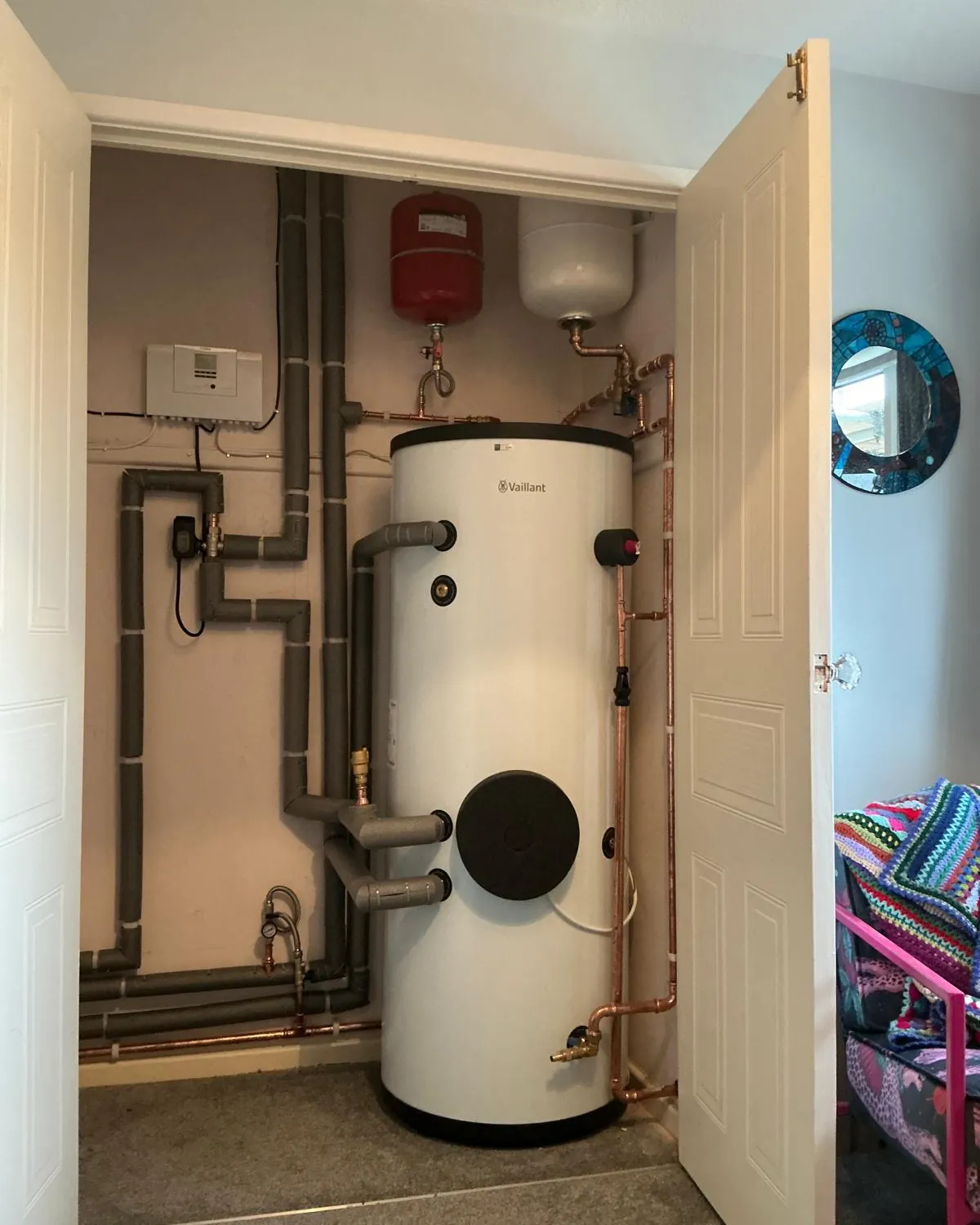
- We fit the cylinder with its expansion vessel, pressure relief valves, and tundish, each one doing a specific safety job.
- The discharge pipe gets routed to a safe external point, following the required drop and distance rules.
- We connect the immersion heater and any heating coil links, then pressure test the whole system.
- Final commissioning includes checking every safety device fires correctly before we call the job done.
That tundish and discharge pipe step trips people up the most — homeowners assume any external wall will do, but the routing has to meet strict safety requirements. Get it wrong and you've got a system that looks fine but fails inspection.
Because unvented cylinders operate under mains pressure rather than gravity, the commissioning stage matters more than people expect. This isn't a bolt-it-on-and-leave job. Our engineers are Gas Safe registered, and that discipline carries through every check on the list above.
Most installs take a day. Older properties with awkward pipe runs can push into a second, but you'll know that before we start, not halfway through.
What it costs. Installation is quoted after we've checked your mains pressure and flow rate, because those decide what the system can actually deliver. Annual servicing afterwards is £174 including VAT alongside a boiler service, or included in the £240 heat pump service — we don't service a cylinder on its own. Full prices are on our rates page.
Certification and Compliance
Here's something a lot of homeowners don't realise: an unvented cylinder isn't like a normal boiler swap. Building regulations require this type of installation to be carried out by someone holding the right competency certification, full stop. It's not optional and it's not a formality — it's the law.
Why does this matter so much? An unvented cylinder stores hot water under mains pressure with no open vent to atmosphere. If the safety devices aren't set up correctly, that pressure has nowhere safe to go. Get it wrong, and you're not just risking a leak, you're risking a genuine safety incident in your own home.
We're Gas Safe registered (No. 584578) and Heat Geek Assured, and every unvented cylinder we install gets checked against expansion vessel sizing, discharge pipework routing, and pressure and temperature relief valve function before we sign off.
Unvented cylinder work here is carried out by a G3-qualified engineer, and we'll show you the certificate before we start. Ask any installer for the same — if they hesitate, that's your answer.
Older systems around Rotherham and Barnsley were fitted decades ago when mains pressure in the area was lower, so a lot of the semi-detached homes built through the 1960s and 70s never had one at all. Homeowners upgrading now are often doing it for the first time.
- Ask to see proof of unvented cylinder competency certification, not just a general gas qualification
- Confirm the installer will issue a Building Regulations compliance notice for the work
- Check the discharge pipe route has been planned before the job starts, not decided on the day
- Make sure the expansion vessel and relief valves are being sized for your specific system, not a standard default
Ask any installer coming to quote whether they can show you that paperwork before you agree to anything.
What our customers say
New water tank
New water tank fitted efficiently and well. I wasn’t looking forward to the mess but there wasn’t any at all. Who knew that there would be benefits to having a new tank, apart from it not leaking? The water stays hotter much longer, the power shower has more power and the hot water runs much faster.
Repair boiler
Called Uber about boiler failure, needed new circuit board. Chris called backnext day with price. Then arranged installation for following Monday. Quick and efficient repair.
Where we work on unvented cylinders
Unvented cylinder work is on our standard rate across Rotherham (S60 to S66), Barnsley (S70 to S75), the Dearne Valley, Doncaster (DN1, DN2, DN4, DN5 and DN6) and north and east Sheffield (S4, S5, S9 and S35). Chesterfield, Worksop, Wakefield, Pontefract and the rest of Sheffield outside the city centre are on our Band A rate, which is the same work with 10% added for the travel. Every postcode, and the few we don’t cover, is on our rates and coverage areas page.
Standard rate
- S60
- S61
- S62
- S63
- S64
- S65
- S66
- S70
- S71
- S72
- S73
- S74
- S75
- DN1
- DN2
- DN4
- DN5
- DN6
- S4
- S5
- S9
- S35
- DN12
- WF9
Band A: same work, 10% added for travel
- S7
- S8
- S10
- S11
- S12
- S13
- S14
- S17
- S20
- S21
- S26
- S36
- S25
- S18
- S32
- S33
- S40
- S41
- S42
- S43
- S44
- S80
- S81
- NG20
- DN10
- DN11
- DN22
- DN3
- DN7
- DN8
- DN9
- DN21
- WF1
- WF2
- WF3
- WF4
- WF5
- WF6
- WF7
- WF8
- WF10
- WF11
- HD8
- HD9
Related services
Frequently Asked Questions
Do I need a new installation, or is this a replacement for my existing cylinder?
If you already have an unvented cylinder and it's dripping, banging, or showing rust, that's a replacement, not a new installation — see our unvented cylinder replacement page for diagnosing and swapping a failing unit. Installation is for homes converting from a gravity-fed system, switching from a combi to a system boiler, or adding hot water storage to an extension or conversion for the first time.
Why are more homes around Rotherham and Barnsley having an unvented cylinder installed for the first time?
Plenty of homes here still run the original gravity-fed setup with a cold water tank in the loft, and a lot of older terraces have lofts too tight for that arrangement in the first place. Extensions, loft conversions and second bathrooms are the other big driver, since they add hot water demand the original system was never sized for. In both cases the answer is usually a first-time unvented installation rather than squeezing more out of the old setup.
Where can an unvented cylinder be installed in an older house?
Many older terraces around Rotherham and Barnsley have airing cupboards sized for small tanks, too small for the 180 litre or larger cylinders growing families often need. That usually means relocating it to a loft, garage or utility space with room to spare. Loft installations need the floor structure checked first, since a full cylinder is heavy. The unit also needs a discharge pipe running to a visible, safe outside point under Building Regulations Part G3.
My hot water runs out fast with two bathrooms in use, does that mean I need a bigger cylinder?
Not always. Sludge build-up in the heating system can starve the cylinder's coil of heat, and a power flush often fixes this without a new cylinder. But if your family has grown since the original tank went in, sizing does matter. We look at bathroom count, peak demand times like morning showers, and your boiler's output before recommending any change in size.
What size cylinder do I need for my home?
It depends on your bathroom count, household size and when demand peaks, not on matching the old tank's size. A cylinder that's too small means cold showers once a second person washes up. One that's too big just wastes heat sitting there. We walk through your daily routine and check available space before recommending a size, so you get one that fits both your family and the room it sits in.
Talk to the office team
Office open Monday to Friday 8am to 6pm, and Saturday 8am to 12pm. Tell us what's going on and we'll book the right visit, in a weekday 4-hour slot: 8am to 12pm, 10am to 2pm or 12pm to 4pm.